Context
The Rosetta Stone was carved during the Ptolemaic period, a phase of Egyptian history that began with the Macedonian conquest under Alexander the Great in 332 BC and ended with the Roman annexation in 30 BC. The Ptolemaic dynasty governed Egypt from Alexandria, administering a kingdom in which Greek-speaking rulers presided over a deeply rooted Egyptian religious and bureaucratic apparatus. The decree inscribed on the stone dates to 196 BC, issued under Ptolemy V Epiphanes during a period of internal revolt and political instability. It records a resolution passed by a synod of priests assembled at Memphis, granting the young king a series of divine honours and tax concessions in exchange for his support of the temples.
The decree was composed in three scripts to ensure it could be read by the kingdom's principal literate communities: hieroglyphic for the priestly class, Demotic for everyday Egyptian administration, and ancient Greek for the Ptolemaic court and its officials. This trilingual format was not unusual in Ptolemaic Egypt — several comparable stelae survive — but the Rosetta Stone's particular combination of legibility, preservation, and historical accident made it the catalyst for decipherment.
The stone was found by French soldiers reinforcing Fort Julien near the town of Rashid (Rosetta) in the western Nile Delta. After the French capitulation in Egypt, it was ceded to Britain under the terms of the Treaty of Alexandria in 1801 and entered the British Museum's collection in 1802, where it has remained ever since. Its arrival in London coincided with a surge of European scholarly interest in ancient Egypt, and within two decades it had become the fulcrum of a fierce intellectual contest between Thomas Young in England and Jean-François Champollion in France.
What to Notice
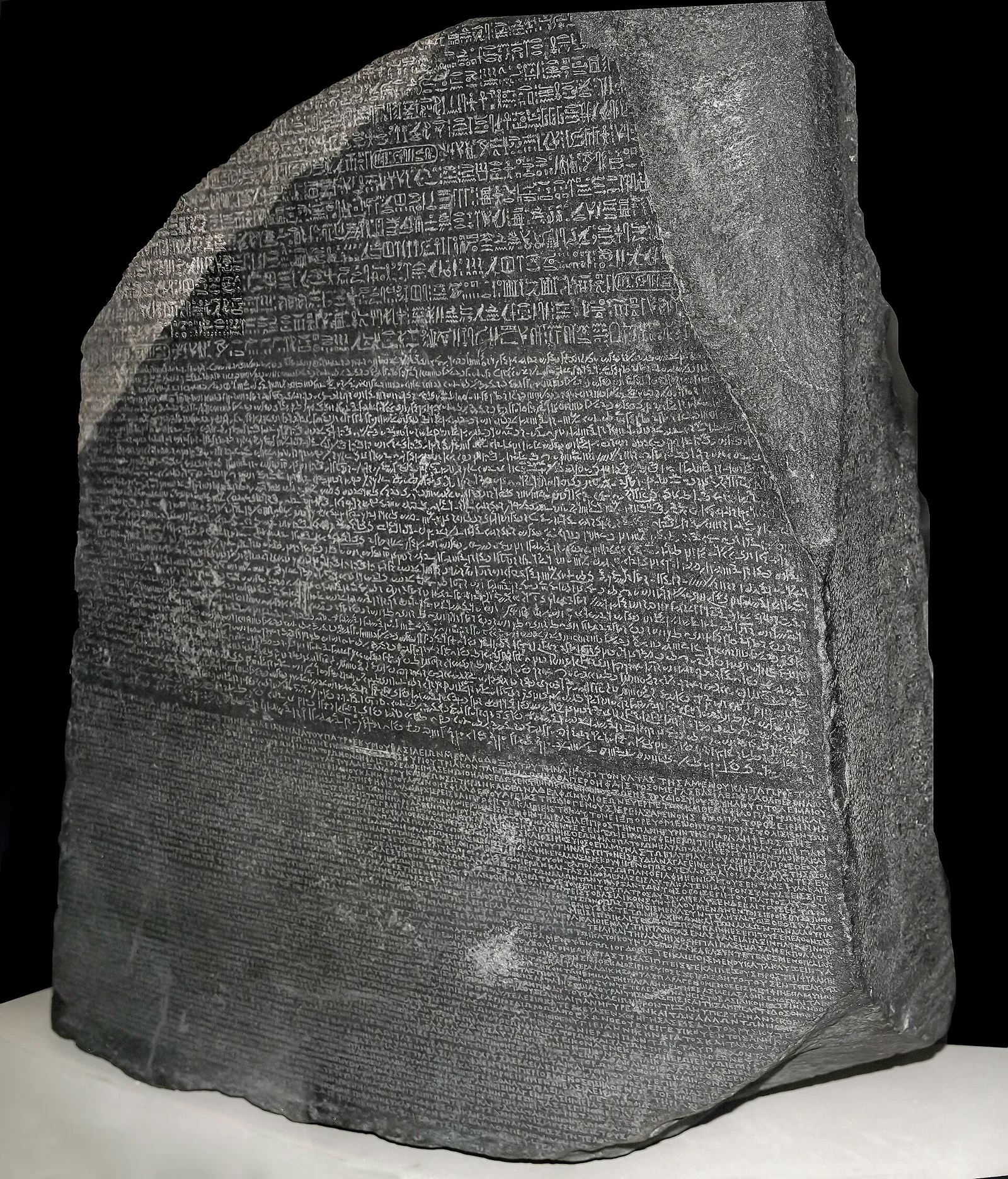
The front face of the Rosetta Stone is the essential starting point. Viewed directly, the stele's surface is divided into three distinct bands of text, each rendered in a different script. The uppermost register, the most damaged, carries fourteen surviving lines of hieroglyphic text — the sacred script of the temples. Below it, thirty-two lines of Demotic script fill the middle section, representing the cursive writing used in daily Egyptian administration. The lowest and best-preserved section contains fifty-four lines of ancient Greek, the administrative language of the Ptolemaic court. Even in a corrected frontal photograph, the differential weathering of the three zones is immediately apparent: the hieroglyphic portion has lost its upper-left corner and much of its right edge, while the Greek text survives almost in full. This accident of preservation was decisive, because it was the complete Greek section that gave scholars their entry point into the other two scripts.
Seen from an oblique angle, the stone reveals details that a flat reproduction conceals. The surface is not uniformly smooth; the Demotic and Greek sections were incised with different tools and at different depths, reflecting the distinct scribal traditions behind each script. The granodiorite itself — dark grey with a faint pinkish tone — is extremely hard, and the precision of the carving, particularly in the Demotic register, speaks to the skill of the stone-cutters. The oblique view also makes visible the white infill of the incised letters, a modern intervention by the British Museum to improve legibility for visitors and scholars alike. Along the left edge, traces of a pink pigment survive from an earlier period of display, a reminder that the stone's physical history did not end with its excavation.
The 1985 gallery display photograph offers a valuable contrast with the stone's current presentation. In that earlier installation, the stele stood upright in a simpler glass case, without the elaborate interpretive apparatus that now surrounds it. Comparing this with the modern gallery setting — where the stone is mounted at a slight angle within a purpose-built enclosure, accompanied by multilingual panels and digital aids — illustrates how museum practice has evolved around this single object, reflecting changing attitudes toward accessibility, conservation, and public engagement.
Points of Interest
The decipherment of the Rosetta Stone was not a single event but a cumulative process spanning more than two decades. Thomas Young, a polymath and physician, made the crucial early observation that certain hieroglyphic signs enclosed in oval cartouches corresponded to royal names — specifically the name Ptolemy. Jean-François Champollion, building on Young's work and drawing on his deep knowledge of Coptic (the last stage of the Egyptian language), announced in September 1822 that hieroglyphs operated as a mixed system of phonetic and ideographic signs. This breakthrough, communicated in his famous *Lettre à M. Dacier*, opened the entire corpus of ancient Egyptian writing to systematic reading.
The stone itself is a fragment. The original stele was probably around 149 centimetres tall; the surviving piece measures approximately 114 centimetres in height, 72 centimetres in width, and 28 centimetres in thickness, weighing roughly 760 kilograms. A rounded top, likely featuring a winged sun disc and a scene of the king before the gods — standard for Ptolemaic decree stelae — is entirely lost. Comparable stelae, such as the Decree of Canopus (238 BC), give a sense of what the complete monument would have looked like.
Sources and References
For editorial verification and public reference, only whitelisted institutional sources with a direct link to the collection, object context, or relevant museum framing were retained.
Institutional sources consulted: