Context
The story of the discovery has become part of modern archaeological legend. Bedouin finders first came upon scrolls in a cave above the marl terraces of Qumran, where cylindrical jars had protected manuscripts for nearly two millennia. Subsequent searches identified eleven caves, though the finds were highly uneven: some yielded substantial manuscripts, while others produced only tiny fragments. Cave 1 preserved the celebrated Great Isaiah Scroll almost intact; Cave 4, by contrast, contained a mass of broken pieces representing hundreds of separate compositions. The manuscripts are usually dated from the third century BCE to the first century CE, placing them within the politically volatile centuries of Hasmonaean rule, Roman expansion, and the decades before the destruction of the Jerusalem Temple in 70 CE.
The scrolls matter because they document plurality rather than uniformity. They show that Jewish scriptural, liturgical, and legal traditions circulated in more than one form, and that biblical books existed in textual states earlier than the later Masoretic standard. Some manuscripts are very close to the consonantal base of the medieval Hebrew Bible; others align more closely with readings known from the Septuagint or Samaritan tradition. The corpus also preserves writings associated with an austere community, often linked by scholars to the Essenes, that imagined itself as a righteous remnant living in expectation of divine judgement. Whether or not every manuscript belonged to that group, the collection reveals a vigorous landscape of interpretation, discipline, and controversy.
That plurality is one reason the scrolls remain central to debates about transmission. They do not simply confirm a single stable biblical text, nor do they dissolve scripture into chaos; instead, they reveal a world in which copying, interpretation, and communal use existed side by side. Legal compositions, pesharim, hymns, calendrical arguments, and rules for collective life show how textual authority was negotiated in practice. The scrolls therefore illuminate both the making of scripture and the making of communities that organised themselves around scripture.
What to Notice
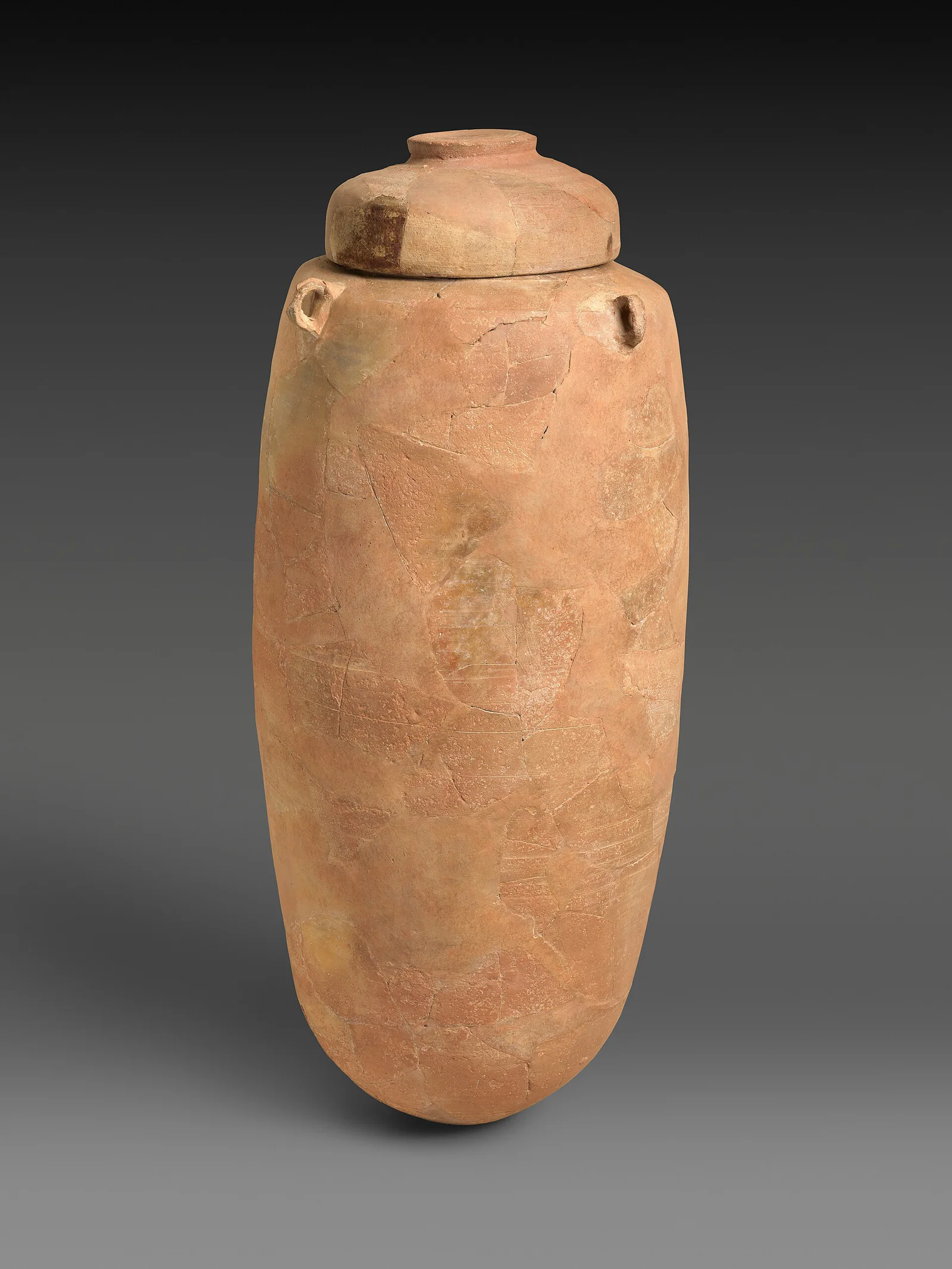
A strong visual reading of the subject begins with the storage jar that serves as this article’s hero image. Its plain ceramic form explains part of the scrolls’ survival story more effectively than any dramatic reconstruction could do. The manuscripts endured because they were stored, sealed, hidden, and left in a climate harsh for people but favourable to fragile organic material. The jar therefore stands not merely for excavation, but for the material conditions of transmission: parchment, linen, clay, darkness, and dry desert air. It is a compact object, yet it anchors the larger theme of preservation across centuries.
The site images of Qumran and Cave 4 make a different point. They situate the manuscripts within an eroded desert escarpment rather than within a modern gallery, reminding the viewer that these texts were found in a landscape of cliffs, caves, and wadis above the Dead Sea. The topography matters because the manuscripts were not recovered from a library in the modern sense; they were scattered through findspots that demand interpretation. Looking at the caves, one notices distance, concealment, and vulnerability. The terrain helps explain why the discovery narrative still carries an aura of accident, but it also underlines how much archaeological context had already been disturbed before systematic excavation began.
The modern Shrine of the Book introduces another layer of meaning. Its white dome famously recalls the lid of a storage jar, translating the conditions of concealment and preservation into a public architecture of memory. The building reminds viewers that the Dead Sea Scrolls are now read through museums, conservation laboratories, and digital imaging projects as much as through excavation reports. In other words, the article’s visual sequence moves from container, to desert setting, to the modern institution that frames the manuscripts for contemporary audiences.
Points of Interest
One of the most consequential aspects of Dead Sea Scrolls scholarship has been the question of access. For decades only a relatively small scholarly circle controlled much of the unpublished material, which encouraged suspicion, overstatement, and popular myth. The eventual opening of photographs and editions in the late twentieth century changed the field decisively, allowing philologists, historians, conservators, and digital imaging specialists to revisit assumptions that had hardened too early. In that sense, the history of the scrolls is also a history of how evidence becomes public.
Another point of interest lies in the methods now used to study them. Multispectral imaging can recover faded writing; palaeography refines dating through letter forms; material analysis distinguishes parchment traditions; and digital reconstruction helps reconnect fragments once dispersed across old inventories. None of these techniques makes the scrolls less human. On the contrary, they reveal how texts were copied, handled, corrected, stored, and reused. The manuscripts continue to matter because they are not relics frozen at the moment of discovery: they remain an active archive for understanding scripture, community, and intellectual life in the ancient eastern Mediterranean.